Intel Could Finally Return to Apple Computers in 2027
- Apple is reportedly testing Intel’s 18A-P process for future low-end M-series chips.
- Early kits are already in Apple’s hands, with a final PDK due in 2026.
- If the schedule holds, Intel-made M-series Macs could ship in mid-2027. Read on...
For a company that prides itself on cutting clean breakups, Apple has a funny habit of circling back to old partners. It happened with AMD GPUs. It happened with Samsung displays. And now, if analyst Ming-Chi Kuo’s latest note holds up, Intel might be next in line for a comeback — though not in the role anyone expected.
It’s strange, honestly. Most longtime Apple fans still remember the drama of the Intel-to-Apple-Silicon transition. One day we were staring at thermal-throttled Intel laptops fighting for air; the next, Apple’s M1 Macs were running circles around them with absurd battery life. So the idea that Intel could slide back into the picture feels almost contradictory. But it’s happening in a completely different context, and the deeper you look, the more it starts to make sense.
 Photo via NewsBytes // Just when you thought 2025 couldn't get any weirder. Rumors about Apple and Intel teaming up are circulating.
So, Why Is Intel Suddenly Back in the Conversation?
Here’s the thing: Intel isn’t returning as a CPU designer. Apple’s not ditching its Arm-based architecture, and your future MacBook Air isn’t about to wake up in cold sweats remembering x86 instruction sets. Instead, this potential partnership is purely about manufacturing — Apple-designed chips, Intel-made silicon.
According to Kuo, Apple has already been working with Intel’s early 18A-P process design kit (PDK 0.9.1), which is basically the blueprint Apple uses to prepare next-gen M-series chips for fabrication. That alone is wild when you consider Intel didn’t even land a spot in the first iPhone, let alone Apple’s current silicon roadmap.
For context, Intel’s 18A-P is one of the first sub-2nm nodes manufactured on North American soil. And that detail matters — not just technically, but politically.
But I’m getting ahead of myself.
 Photo via NotebookCheck // Apple M7 chipset.
A Quick Word on the PDK Situation
PDKs aren’t glamorous. They’re the sort of thing chip engineers obsess over while the rest of us squint at Geekbench scores. But PDK 1.0 (and the slightly refined 1.1) is the version Apple needs before it can finalize the silicon design for real production.
Right now, Intel is expected to ship that version sometime in the first quarter of 2026. If the stars align — meaning the PDK doesn’t introduce weird quirks, yield issues, or late-stage headaches — Apple could greenlight manufacturing in late 2026. That would put Intel-made M-series chips on the market around Q2 or Q3 of 2027.
And yes, that’s a very “if everything goes perfectly” timeline. Anyone familiar with semiconductor schedules knows that nothing ever goes perfectly. But the fact that Apple is even entertaining this possibility says a lot about where Intel’s foundry ambitions are heading.
What Chips Would Intel Actually Make?
This is the part that most people misunderstand.
Intel wouldn’t be building the flagship chips — not the equivalents of M3 Pro, M4 Ultra, or whatever Apple cooks up after that. Instead, Kuo says Intel would handle the lowest-end M-series chip, likely the base M6 or M7.
Think MacBook Air.
Think iPad Air.
Think entry-level iPad Pro models.
Lower-end doesn’t mean “weak,” of course. Apple’s base M-series chips already punch above their weight, and the manufacturing process doesn’t change the architecture or the feature set. It’s kind of like switching bakeries but keeping the same recipe — you’ll still get the same pastry, but the kitchen it’s baked in changes.
TSMC, meanwhile, would continue to handle the higher-volume, higher-performance parts. Apple trusts TSMC with its crown jewels, and that’s not going to shift overnight.
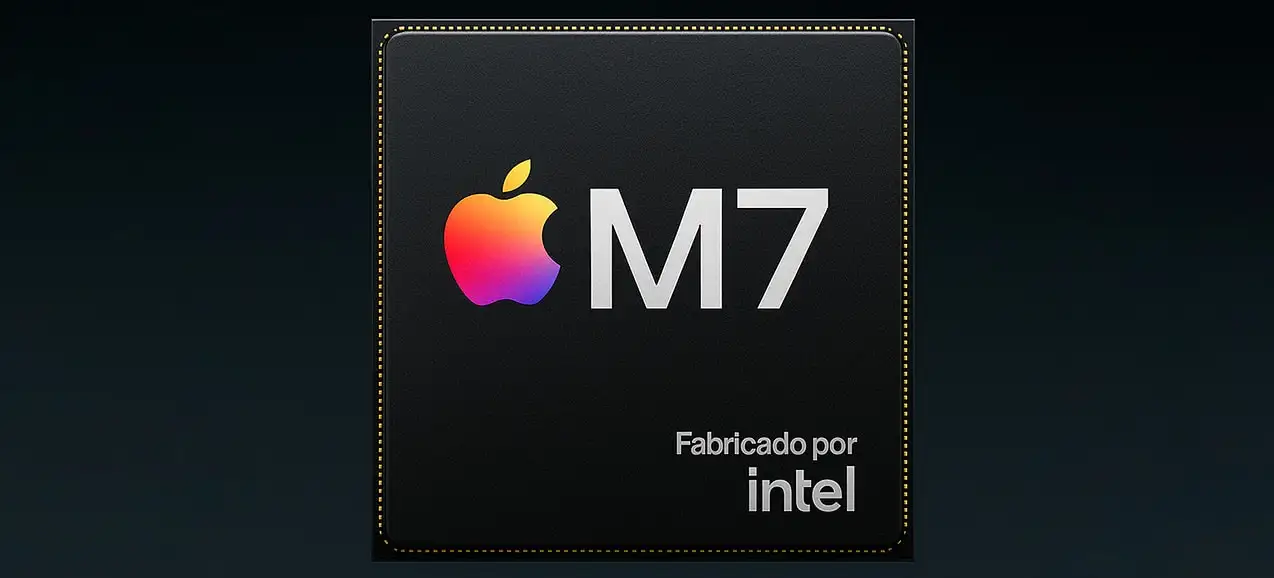 Photo via Informatico // A concept rendering of Apple's upcoming M7 chipset (somewhat jokingly).
Why Would Apple Do This?
A big part of this rumor ties directly to US politics. With Trump’s administration strongly promoting “Made in America” supply chains — and openly pushing US companies to source silicon domestically — Apple partnering with Intel would be an easy way to show cooperation without sacrificing performance.
You know what? It’s a clever move. Apple gets political goodwill. Intel gets a huge client. And Apple fans get the reassurance that the company isn’t tying 100% of its silicon destiny to Taiwan at a time when geopolitical tension is high.
There’s also a quiet strategic advantage: diversification. Depending entirely on one foundry, even one as proven as TSMC, carries long-term risk. Apple likes redundancy the way pilots like backup engines.
Intel’s Redemption Arc Is… Surprisingly Compelling
Let’s be honest — Intel hasn’t had the best decade. From process delays to losing Apple as a CPU customer, the company felt like it was stuck in a rut. But the 18A-P process, along with the more advanced 14A roadmap, marks a turning point.
The 18A-P node uses RibbonFET transistors and PowerVia backside power delivery — technologies that Intel has been promising as their next big leap. These aren’t buzzwords; they’re real architectural shifts that could let Intel compete meaningfully with TSMC again.
If Apple signs on, it signals confidence not just in Intel’s tech, but in its future. And tech enthusiasts love a comeback story almost as much as they love a teardown video.
What Will This Mean for Regular Apple Users?
Practically speaking? Not much. Your MacBook won’t suddenly behave differently just because the chip was manufactured in Arizona instead of Taiwan.
Battery life, performance-per-watt — everything that makes Apple silicon feel so… Apple — all of that comes from Apple’s design, not the foundry that stamps out the wafers.
There might be small thermal differences or slight variance in power efficiency, but Apple already calibrates across multiple foundries for other components. They’re extremely good at smoothing out those bumps.
So no, you won’t open your 2027 MacBook Air and think, “Wow, I can feel the Intel in this.”
Are We Heading Back to Intel Macs?
This is strictly manufacturing. The architecture isn’t changing. Apple isn’t rewriting macOS to support Intel CPUs again — in fact, macOS Tahoe will be the last major update for Intel Macs. That chapter is closing.
But manufacturing? That’s a very different story, and Apple is far more pragmatic there than people realize. If Intel’s foundry becomes competitive again, Apple will absolutely take advantage of it.
Closing Thoughts
There’s a certain poetic symmetry to this whole rumor. Intel missed out on the iPhone. They lost their position inside Macs. But now, in a kind of unexpected twist, they might help power the next generation of Apple devices — not with their designs, but with their factories.
It’s a small role, sure. But it’s a meaningful one.
And if everything plays out the way Kuo suggests, 2027 might be the year Apple and Intel quietly reconnect — not as rivals, not as dependents, but as two companies finally meeting in the middle of a very complicated, very modern semiconductor landscape.
One thing’s for sure: the next few years in chip manufacturing are going to be fascinating. And maybe a little chaotic. But honestly, that’s what makes this industry fun to watch.
Recommended by the editors:
- No More September iPhones? Apple's Strategy Shift Changes Everything
- MacBook Pro M6 OLED Rumors: Release Date, Price, Features, and More
- 2026’s Top 250+ Wallpapers: The Ultimate Collection for iPhone, Android & More
- iPhone 18 Rumors: Apple Reportedly Testing Under Display Face ID
- Apple’s Colorful, Low-Cost MacBook: Rumors, Release Date, Features, and More
Published to Apple Scoop on 2nd December, 2025.