Apple A19 vs A19 Pro: What Sets Them Apart? A Detailed Comparison
- Apple's 2025 iPhones are here—powered by A19 and A19 Pro.
- “MacBook Pro levels of compute” for AI is the claim—extraordinarily bold, even for Apple.
- Here's everything that sets the A19 and A19 Pro chips apart.
Apple’s fall lineup brings two fresh phone brains with familiar names and very different ceilings. The A19 powers the standard iPhone 17, while the A19 Pro sits inside the ultra-thin iPhone Air and the flagship iPhone 17 Pro and Pro Max. On paper they share a lot. In practice, the Pro part leans harder on graphics, cooling, and sustained speed—all the things you actually feel after the honeymoon week.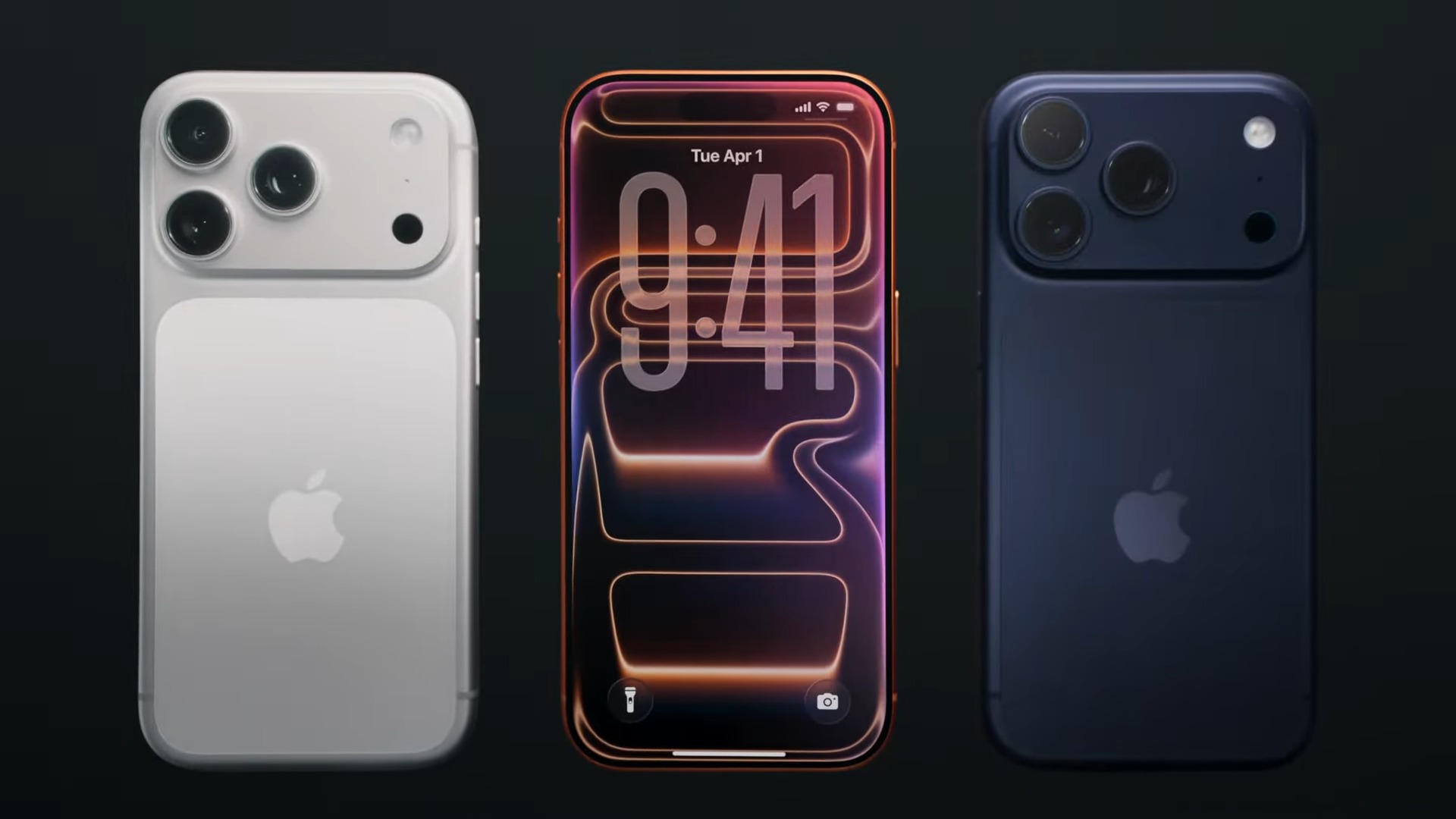 Photo via Apple // The iPhone 17 series is officially here, and Apple says: "you're gonna love it."
What Apple launched
There are four phones: iPhone 17, iPhone Air (a 5.6-mm design), iPhone 17 Pro, and iPhone 17 Pro Max. A19 goes into the base model. A19 Pro runs the Air and the two Pro phones. Both chips are likely built on TSMC’s N3P process, the same next-gen node widely expected to underpin Apple’s upcoming M-series refresh.
A19 and A19 Pro
The CPU blueprint is the same across both parts: six cores total, split into two performance and four efficiency cores. Graphics features also match conceptually, with hardware-accelerated ray tracing, mesh shading, and MetalFX upscaling in the mix. That’s the shared foundation.
 Photo via Apple // A19 Pro, the brains behind iPhone 17 Pro and 17 Pro Max.
How are they different?
The split shows up in the GPU and how long each phone can hold peak performance. A19 carries a 5-core GPU. A19 Pro scales higher—up to six GPU cores in the iPhone 17 Pro/Pro Max—and that extra core is only half the story. Apple also reworked the Pro chip’s CPU microarchitecture, citing better front-end bandwidth and branch prediction on the performance cores plus a 50% larger last-level cache on the efficiency cores.
Apple’s headline claim: iPhone 17 Pro delivers up to 40% better sustained performance than iPhone 16 Pro. The obvious assist comes from a new cooling approach in the Pro phones: a vapor-chamber thermal system inside an aluminum unibody that Apple says is “20 times better at cooling” than the titanium design used in iPhone 15 Pro/16 Pro. That should help the Pro models hold clocks longer under load. The iPhone Air also uses A19 Pro, but without that vapor chamber—so expect the same architecture with stricter thermal headroom in a thinner shell.
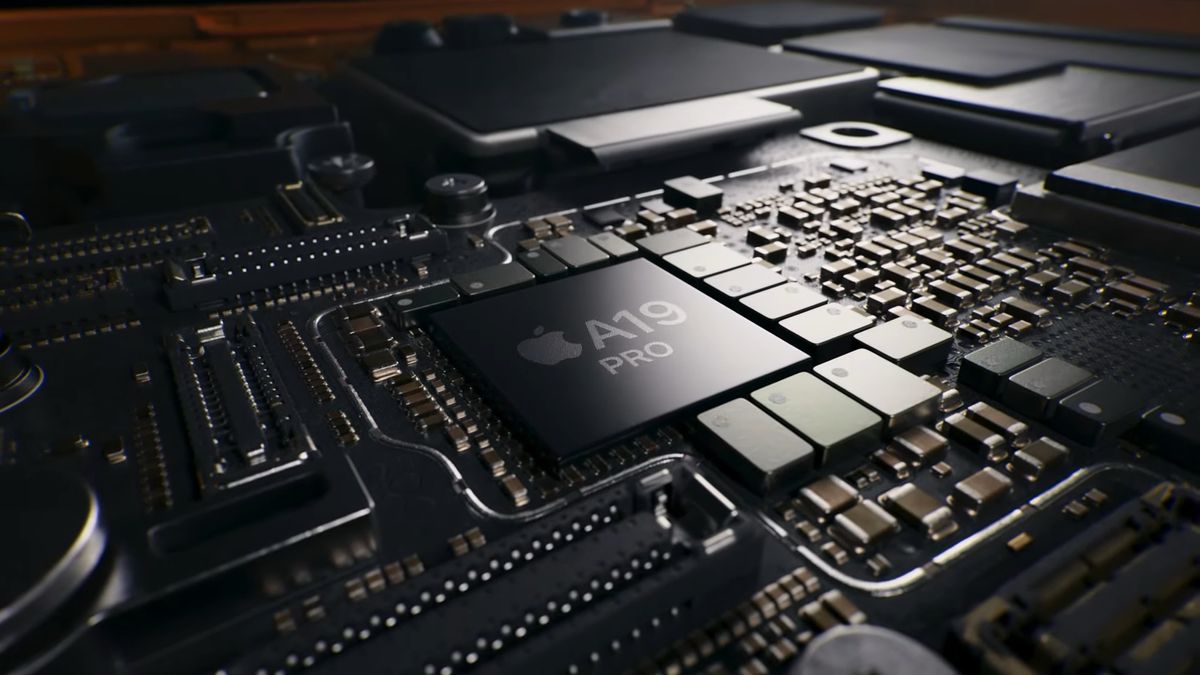 Photo via Apple // Apple showed off the A19 Pro chipset inside of a Pro-model iPhone.
AI, GPUs, and the quote everyone will remember
Apple framed this generation around GPU-heavy AI workloads. In iPhone Air, the company points to neural accelerators on each of the five GPU cores and claims a 3× gain in peak GPU compute versus last year’s A18 Pro. And then came the line that will be replayed all season:
This is MacBook Pro levels of compute in an iPhone, perfect for GPU-intensive AI workloads.— John Ternus, Apple SVP of Hardware Engineering
It’s a bold comparison without naming a specific MacBook, but the message is clear: on-device AI is moving center stage, and Apple wants headroom to match. For context, A19 Pro includes a 16-core neural engine across both iPhone Air and iPhone 17 Pro.
Networking and cellular
Apple’s in-house N1 wireless chip appears across the lineup, handling Wi-Fi 7, Bluetooth (listed as Bluetooth 6 in the materials), and Thread. Apple says bringing these radios under one roof should boost everyday features like AirDrop and Personal Hotspot with better performance and efficiency.
On cellular, the story splits. Apple’s updated C1X modem claims up to 2× performance, but it doesn’t support mmWave. Meanwhile, iPhone 17 and iPhone 17 Pro that use Qualcomm modems retain mmWave. If you frequent mmWave-lit arenas or dense downtowns, that difference still matters.
Prices and dates
Pre-orders open Friday—with a noted window of Sept. 12 at 5 a.m. PT for iPhone 17 Pro/Pro Max and iPhone Air—and retail availability begins Sept. 19. Starting prices (USD): iPhone 17 — $799, iPhone Air — $999, iPhone 17 Pro — $1,099, iPhone 17 Pro Max — $1,199. Every model starts at 256GB, and for the first time the Pro Max stretches to 2TB.
Apple also used the stage to unveil AirPods Pro 3, Apple Watch Series 11, Watch SE 3, and Watch Ultra 3.
Final thoughts
If you game for hours, render video on your phone, or you’re curious about where on-device AI is actually heading, A19 Pro—especially inside the Pro models with that vapor chamber—makes the stronger case. The iPhone Air gets the same brain with a slimmer body, which is lovely in the hand but naturally less forgiving under prolonged stress.
If you want a fast, efficient iPhone and you’re not chasing every last frame, A19 in the iPhone 17 will feel plenty quick and pleasantly cool. And yes, that’s probably most people.
Recommended by the editors:
- Is Apple Dropping New Hardware on November 12? The Rumors Say Yes
- M5 MacBook Air Rumors: Release Date, Specs, Pricing, and More
- Apple M5 Explained: Everything You Need to Know
- M5 MacBook Pro (2025): Release Date, Specs, Pricing, Preorder, and More
- Apple M5 MacBook Pro, iPad Pro & Vision Pro: Specs, Price, Release Date
Published to Apple Scoop on 9th September, 2025.